
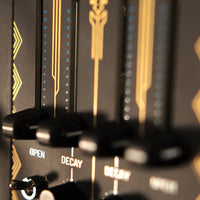
 Instrument Design Journey: Natural Gate, Part 1 - Introduction
This is the first post in a new series which documents the journeys we take in making an instrument. We feel it might be nice to have the stories behind something you may use in your own creative ways. And maybe for other designers or hobbyists, too; to see some of the ways others like to work.
The real moment which realised what we see as the novelty of Natural Gate came down to an accidental ‘blip’ where I was lite. Without this moment, I would have still been scrambling at the drawing board and may have even given up on the project altogether, as with countless other projects in my life.
At the time, I didn’t know what ‘lite’ meant nor was it formulated into a whole sort of philosophy we try to operate by today and spend considerable time refining. But to understand the moment it ‘clicked,’ we first start with my situation beforehand.
I was working a normal, decent-paying job with benefits and all of that nice stuff. I also did some consulting work on the side. It was stable and secure… but at the same time somewhat unsatisfying. I started designing my version of a LPG during this time. I had experimented with the typical LPG circuits, all of which used vactrols. I realised after a while that it was the vactrol itself that was limiting what could be had. They were also kind of poor devices - they didn’t 'close' all the way in these circuits, had crazy drift issues, and they really needed to be hand selected. Couple this with their cost and the nasty materials used to make them - they were just something I didn’t want to work with let alone use in anything I made. I even remember my guitar amp days - old Mesa Boogie amplifiers that used them for channel switching… what a mess. For channel switching in my amplifiers, I would just use some JFETS or any of other number of better engineered solutions. So why vactrols?! Exactly! I was never one for tradition and so it was an easy move to try something new.
Tradition! We do not need so much tradition here, my friends!
And so I started looking at ways to bypass the need to use these devices. At the time, I was in the depths of how to emulate this device. I didn’t have any strong musical context, nor I hadn’t really asked why I was trying to emulate it in the first place - it was just a matter of replacing it. And so I tried some analogue methods to create the curves of a vactrol.
Early on, I knew I needed and wanted adjustable decay. But these first circuits were finicky, didn’t sound quite right, and were always a compromise between long and short decays. I was stumped and couldn’t think of a better analogue solution. So I then decided to try the digital approach and brute-force it. After some initial testing we realised that we needed very high resolution and speed to get the detail we needed at the snappy end of the spectrum. We wrote some software, played with some DACs n Bessel filters, and had some basic thing going. I was again left torn; it didn’t seem to fit the purpose of the device nor was it an elegant solution to me. So it sat. I was a bit frustrated - yet another design stuck on the bench. It made it even harder to come up with a decent solution. The more I tried, the less I could think clearly. I was grumpy and unpleasant; something I’ve been prone to my whole life and still struggle with today, on occasion.
At the same time, I was spending my entire day doing something that I didn’t really want to be doing any more. I was bored and stale. I wasn’t being challenged and yet I had no energy to take on my own challenges. I couldn’t think clearly. And so at some point, you get fed up enough (if you are paying at least some attention) that you decide to do something drastic. And that was to resign. I’d talked about quitting for a long time but the comforts seemed to keep that thought far in the background. But this time was different and I was ready. I had another path and I was ready to take the plunge. I sent in my resignation letter and that was that. Many people thought I was crazy or there was something wrong with me for leaving. This time, however, I decided not to listen and carried through with my plan. And so my new journey had begun! Now I could finally devote *all* of my time and energy into something instead of having to piece it together here and there. It was a very unsure time and I would be lying if I said I wasn’t afraid of the unknowns ahead. But the decision was made and it was time to GO.
Stay tuned for Part 2 of this journey!
Copy blog RSS feed url here
 Frontloading: Vector over Raster
This is a fun one! What we are talking about here is a way to front-load a live/studio rig such that you ideally only bounce/record the audio once you are at later stages of completing a track.
It comes down to storing control signals (which you can change easily!) instead of recording the resulting audio (which you *cannot* change easily). It's a shape drawn with vector data (equation driven) vs literally putting the shape into pixels (raster data). Illustrator vs Photoshop, in a way.
Caveats first: Of course this will not work with certain things. It assumes you have access to control signals in the first place. An acoustic instrument doesn't have recordable control signals - the controller is the human - their muscles. And so the result of that is always audio (unless you are Pat Metheny's Orchestrion control driven acoustic machines - also check out Simian's Murmurations as they dive into this as well).
That being said, you may ask yourself how many times have you committed to audio to only realise you are in a world of hurt behind a computer applying all sorts of EQ, compression, cutting, pasting, etc to the audio files themselves. And right next to the computer sit the instruments that have created this audio. Why not get it right from the start? Or at least encourage and grow this type of workflow.
One of the problems is that magical moments are hard to capture. And we know all about this. Those who use modulars *really* know about this. When we came to terms that recording audio was the only way to save a magical moment, we thought something was just off with the process. And so we began a several year process to make a rig that doesn't have to be this way. You can read the process for that system throughout our Content pages.
It turns out that if you were to control every parameter and simply record that data, you can recreate the audio the same way every time. This assumes ideal control voltages and enough resolution and accuracy, but bear with me here. The point is that if you, for example, were to take every parameter of your synth and send the same signals back to it, the sound will be the same as if you just recorded the audio the first time you came up with something you liked.
The big difference, however, is that you can change control signals. Why would you need to change anything in the first place, you may ask? Just ask why you would ever need to do any post processing, EQ'ing, alter the dynamics, repitch, chop/copy/paste, etc. any audio? Have you ever done any of those things on audio files? And what about a magical moment on a modular - but the phrase or rhythm isn't quite right... or you want to add a simple variation to a very loopy sequence created from a very basic hardware sequencer (they are all quite basic, when you compare this to what can ultimately be done with a DAW or directly via human performance).
One big reason we change things is because we do not know what will come in the future. We may add other voices that do not play well with the original material. We may need to transpose a song once you start realise the newly added bass track is not sitting right or is too heavy - yet if you move it up, everything is out of tune and repitching audio ruins its fidelity... You may need to add a variation that you hadn't thought of with the original sequence that is needed to transition to a new song section. The possibilities are endless. And they are completely to be expected. Knowing this, we simply ask: do you want to fix things after they are baked as audio (which is painful for us) or could you simply reset the controls to make the changes you want directly? To us, we would always prefer the latter.
So think about this! It's a workflow change as well as a method to record/store/edit the control signals rather than the audio. In many cases, it is more than possible to 'fix it at the source.' We maybe have gotten into a habit of mixing 'later.'
A final example might also help you with the whole shift of post to source...
We design modules. Let's use our Portal Kick as an example. Kicks are notoriously difficult to get just right. And much of that process is done in the box or at least after some initial kick audio is recorded. We said no. We built the mixing of our kick into the module itself... it was the ideal exercise in frontloading!
We do 'compression' by adjusting and creating custom envelopes to the point it doesn't need compression in a song to alter the cuttiness of the kick. We were EQing the kick in songs so we built that exact EQ profile into the circuit. We found we were HPFing the kick so it wasn't so heavy all the time (which is a common trap, BTW... making kicks too heavy). So we built a HPF right into the module. We were laying 'clicks' and 'ticks' onto a very low frequency core sinusoidal sound. So we completely redesigned the core so that they were built right into the VCO itself. Not even a layer; these clicks and ticks sound like they are part of the kick. We were adding some impurity to the sinusoids via clipping plugins (and were left only moderately happy). So instead we built our own form of distortion into the module. Everything you could do to a kick track we built right into the source and this is as early as you could put it. You can plug it right into your drum bus and it can be tuned in a final way without additional mixing elements (though bus compression is something we cannot account for on individual voices :D). Add CV control as well so you can get every one of those settings back. You can readjust the click after you've added your hats and need the click to sit in a different spot. You can retune the kick, you can add some HPF to give it more room for the bass track. And now imagine doing all of those tasks if you only had some non-ideal audio instead. It's wrong. It doesn't make sense. Again we are slaves to a mandate given to us by tradition or lack of context when designers create the technology we use. Fortunately, we are at a point where the technology is so powerful, all we need to do is constrain and design a system around it.
Try frontloading a bit! Think about it and see if it would help your workflow and your music! And be sure to check out our upcoming discussions on the system we have configured to do such a thing. Exciting!
Copy blog RSS feed url here
 What goes into our Instruments...
Instruments first come out of a personal musical need. This need then transitions into a process of rigor and carefully paying attention... always in the context of music. We design, tweak, and test while working on music. We incorporate even early 'drafts' into our music making systems. So there is always purpose throughout.
We try to work only when our minds are clear and hearts are vulnerable. This is how we can be truly honest. This sort of clarity and vulnerability takes lots of mental preparation and practise. We also employ a Listener-Operator dynamic, which we will be posting on this site in the future!
For more of the nuts and bolts, read on...
Components
Controls
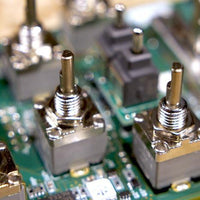
We use low-noise sealed conductive plastic element potentiometers rated for 1 million cycles. This is 100x longer than the carbon pots found in most other electronics. Our pots also feature solid metal bushings and shafts for ruggedness. The feel is perfect. Not too fast, not too slow and silky smooth. Faders are also conductive plastic and rated for 100k cycle life, 10x longer life than most others.
Knobs are a custom shape we came up with after maybe 100 or so prototypes over the course of several years. They are now made for us by Kilo International, precision CNC'd out of aluminum, bead blasted for a smooth, yet grippy surface, then anodised. They have a CNC cut paint-backfill line (so it will never wear off).
We use premium optical encoders instead of inexpensive mechanical encoders which wear out and begin skipping steps in only a few years of moderate use.
Tact pushbuttons are sealed and rated for 1 million cycles or better. We use Salecom silver contact toggle switches featuring 100k cycle life.
Passives
We use high-spec, low noise, low drift, low tolerance, low tempco resistors. All resistors are at least 1% tolerance and 0.05% in 'generic' critical areas, typ. 25ppm. For ultra-precision reference circuitry, we use 0.05% laser trimmed matched resistor packs. All signal path resistors are thin film and spec'd for very low distortion and excellent linearity. We also spend similar care in selection of the right capacitors choosing soft-term MLCCs for any part sizes over 0603 to avoid layer cracking, a failure mode in hi-rel applications. All passives are automotive grade or better with extended operating ranges.
Op Amps
We use some of the highest performance op amps available to date for ultra-high precision and negligible temperature drift. This allows for simpler, higher precision signal paths. Noise and THD are negligible for these devices. They are also rail-to-rail which means you gain nearly 4V total headroom over other commonly used devices.
Connectors
Power connectors are keyed, latching, long-life, low resistance gold plated Samtec Rugged Mini-Mate. We use 24 & 20AWG wire which provides very low voltage drop compared to ribbon cables which use 26-28AWG wire. Our power cables will last over 3x longer than typical Euro power cables all while providing lower ground losses and less noise - which becomes more and more apparent as a modular system grows in size. We now offer a default Eurorack ribbon cable for those that wish to remain in the standard they are used to but this connector/cable is also of high quality.
Board to board connectors are gold plated Samtec 'four point' contacts for high reliability and low contact resistance.
Front panel connectors are isolated 3.5mm jacks so we can better control the path of chassis noise. They also feature a dedicated ground contact. We have these jacks custom made for us with special platings and contact ratings which doubles the life from 5k cycles to 10k cycles. These are the longest lasting 3.5mm jacks you will find.
Panels
We have recently changed our panel technology to a fiberglass-based panel. This has nothing to do with cost (they actually cost more the way we have them made!) We did this to provide a much better aesthetic (gold is real gold, not a yellowish printing) and the silk screen pops and is much easier to read in low-light conditions. We can also do more clever things with lighting and surface switches as well. And there is a nice texture with the matte finish with semi-gloss ink accents. We mill proper Eurocard compatible slotted mounting holes for use of captive screw fasteners (contact us for details) so no more dropping or losing screws.
We also put brushed ferritic stainless backing plates on all of our modules. This offers EM shielding, a bit of thermal isolation, and keeps the electronics of the module protected.
Design
Ergonomics and Playability
Tactile feedback and ergonomics are essential for an instrument to become a natural extension of the body and mind. Our instruments feature comfortable, easy, and inspiring user interfaces.
Our user-interface layouts and aesthetic come from Hannes Pasqualini. You can learn more about his excellent work here. He has saint-level status for being able to work with us as picky and rigorous as we are :D
Precision
Some of our instruments feature repeatable precisions in the sub-100uV range over full application temperature range. This unique level of repeatability allows you to keep magical patches just the way they should be when you find them.
Power and Grounding
Our modules feature separate analogue, digital, and chassis grounds in order to carefully control noise from entering precision CV or audio signals..
A rugged properly polarised, latch-locking power connector is used on all of our modules. It features lower contact resistance and large wire for lower drop across your modular system (which results in lower noise floor).
We add active, high-speed, low-loss reverse voltage protection for maximum headroom and over-voltage protection for digital sections. All rails feature over-current protection. For any module with digital devices on-board, we provide user-selectable voltage source for those without a dedicated 5V rail.
Reliabililty
We expect our instruments to be lifetime instruments. You won't worry about scratchy controls, skipping encoders, uneven/sloppy 'feel', snapping off a knob, or any of the other issues you've likely encountered with inferior electronics. We feel our design and build quality and overall unwillingness to make compromises is something largely missing in products produced today.
Burn-In
All of our products are fully burned in for 24 continuous hours before final testing. This increases the chance any semiconductor, joint, or other failure modes are discovered before the instrument is shipped.
Software
All software is professionally designed and tested which means fewer bugs and quick, responsive operation. Our menus are almost always 1:1 and for less frequently used settings or modes, we limit menu depth to 1 additional layer - but are still sure to clearly mark them on the panel.
Manufacturing
Our stuff is manufactured by a CM who specialises in military/medical devices for mission/life critical electronics. We flew around touring many CMs across the country putting each manufacturer under the well-polished RE lens. When we walked in the doors of one in particular and met every person asking hard questions, we had a great feeling. Their floors are so clean you can eat off of them. We even checked the maintenance rooms - they had a John Deere mower in there and the landscaper hadn't left even a single rogue blade of grass on the floor where the mower was stored. The people there care so much about what they do. The work areas were clean, spacious, well-lit and full of photos of their loved ones. They all understand what they do matters and had a very tangible sense of pride. Our CM is only interested in making the highest quality assemblies possible. And while this way costs a bunch of money, It gives us the peace-of-mind, less stress, and allows us to continue doing this; making lots more units than just the few we need for our own musical work all while being able to remain light and not worry about the high levels of stress manufacturing can surely stir up! So it's a great fit and we know this relationship will keep us going - something sustainable!
That's the end of this little writeup. Hopefully y'all understand why our stuff takes so long to design and what our standards look like.
So, in short, we strive to make *really good stuff.*