
 Sequencer Update 21619
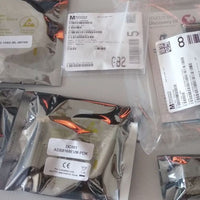
EVMs have arrived - it's software time! Originally this was planned to be a fully analogue sequencer but new direction gives us 'options' for the future of the machine.
 RE to make Sequencer!
We have been wrestling with the sequencer concept for a very long time now. Hardware sequencers were always kind of a let-down in terms of how far you could go musically. We'd always have to use several sequencers to sequence (modulate) another sequencer. And so they remained just little 'rough idea' machines. At the other end, larger, super powerful hardware sequencers had the power to take a rough idea and go much farther in terms of phrasing and arrangement, however, they were not so fun to use - we found it faster to 'edit' these sequences in a DAW with clicky mouse - *a lot* faster. And if they weren't immediate or fun, then why not just do it in the DAW?
Our sequencer history started with a sequential switch, then into a few years of a huge, DAW replacement sequencer with arranging capability, tons of outputs, MIDI, etc. But this sequencer, while having some very powerful concepts and better editing paradigms, still didn't sit right with us. It wasn't quite fun or inspiring enough - which is what we really loved in our favourite hardware sequencers, despite their 'make a full song' inabilities.
Recently, we found ourselves trying to find suitable sequencers for our 'Elephant Rig' and kinda came up short. So we went back to the drawing board, programmed up several Max plugins, and challenged ourselves to come up with the most musically inspiring and *fun* sequencer concept that we could. And so recently, we hit a special moment where it all came together musically - it made sense and all of the features complemented each other perfectly. So much so that we decided to immediately start development of our own hardware sequencer.
It will be released for Euro as a perfectly WYSIWYG machine to retain 100% immediacy (which is a main point of modular). We currently have it planned with an expander which adds more 'digitally' kinds of things like MIDI, a clocking system, quantisation, USB, 'hidden modes', etc...
We are also investigating releasing it as a standalone machine a bit later with some more DAW friendly features and more 'savey' kinds of things suitable for folks who want to use it outside of the modular environment.
We'll post some teasers and fun updates as we go!
 Instrument Design Journey: Natural Gate, Part 4 - Materials
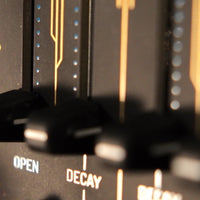
There was an extra bit of work required to get the new envelopes fast enough. It turns out that of all the op amps I tried, they simply didn’t have enough drive current to charge up they heavy instantaneous load of the new envelope circuits. And so I wasn’t getting the hardest of materials from NG even though the curves were very close. Zoom in and I found an unwanted rolling off of the very fast attack portion of the envelopes. And it was absolutely audible!
So I had to build in a current driver that boosts the available drive current of the HIT/CTRL stage. This worked rather well and just like that the characteristic ‘hitting something hard... hard’ could now be heard.
If you use one shape, you have one material. And the material I had was a hard one. But what about softer sounds? NG can be very sharp and cutting (BTW, we find NG is easy to mix around - it cuts quite well in a mix!) but sometimes you do not need or want this. Sometimes you want things that are a bit more subtle. Most of this lies in the attack portion of the envelope. And so we decided that altering the shape of these envelopes further would give us some different material options. This includes rounding over the attack portion as well as reducing the overall height of the envelope signal. Because NG is very 'filtery,' this does indeed mean softer where 'soft' means both quieter (volume) and roll-off (spectral content). We were tempted, initially to normalise the volume so that there wasn't such a big jump between materials but after a quick test decided this was a bad idea and that a more filtered signal, even at the peak of the softest material EG, sounded like it should - soft.
On that note, keep in mind that the CTRL level also affects the vertical positioning of the envelope signal inside NG. So you can get some in-between settings. This is why CTRL input is normalised to a DC voltage. We sometimes bias it a little higher and sometimes we pull it back for very dynamic velocity-based strikes. Try it out! In fact, NG is calibrated such that the CTRL input isn't fully 'zero' but since the closure of NG is "a lot," we still have some room to play with how the tail can be biased up or down. And this is exposed to you via CTRL. Play with CTRL bias - subtly - to see how it affects the sound.
Stay tuned for Part 5 "Memories of Closure" which will be the final installment of the NG Instrument Design Journey!
Copy blog RSS feed url here
 Instrument Design Journey: Natural Gate, Part 3 - In the Woods
Shortly after brewing up the new envelope circuit, we tested the design against our favourite LPGs. We had our beta tester over for some additional perspective (our beta tester is especially fond of LPGs and had similar issues with them as I did when starting this project). All was going very well... but after we got the perfect 'vactrol response,' another moment of clarity hit:
“Why am I trying to recreate a vactrol envelope?!”
I mean, I liked how they sounded… but the reality is that the fact a vactrol ‘sounded good’ was somewhat accidental or indirect. Their intended application, I mean, wasn’t to make LPGs and whatnot. You can read about their history here. A designer of musical instruments and one with a musical brain didn’t create the vactrol curve. It was the isolation and linearity of the resistive element that was appealing to engineers. The curve itself comes from the way the light and the particular sensor responded to each other. It just happened to sound kinda nice when someone started putting them in these circuits and so people used them. And the fact that they are extremely simple to use means they were a go-to device for designers and especially so for those starting out in circuit design. But I no longer had the restriction of having to use a vactrol. And so I could make whatever curve I wanted! Some form of nerd freedom.
And so the relentless yet innocent childhood question of ‘why?!’ started to be a part of my vocabulary again. I remembered why I even wanted this device and the reason was clear - I wanted natural sounds. Then I thought about the kind of natural sounds I wanted to hear... They were staring at me through the window and they called me to come see them as intimately as I wanted. I quickly gathered up a bunch of striking objects and ran into my woods. I starting hitting all sorts of things. Things that were hollow, hard, and rang out, things that were soft, damped, even moist. This was fun! And I was listening. I was creating context.
I recorded them then spent a little time analysing the envelopes and transients of my favorites. I figured out what kinds of shapes I needed and wanted to hear in music. The problem was simple now - just make those curves!
I made a fairly elaborate (and finicky) calibration system for all of the shapes to be made. I think it was something like 10x trimmers per channel. After several weeks of testing and tweaking, we had our ‘golden envelopes.'
Stay tuned for Part 4...
Copy blog RSS feed url here
 Instrument Design Journey: Natural Gate, Part 2 - A Measurable Glance at Liteness
A short time after I sent in my letter of resignation, it was my final day and I said goodbye to my friends and colleagues. They all brought in all sorts of homemade food. A great time and a great send-off - it made me wonder again whether I was making the right decision. But I walked out of the door for the last time as an employee nevertheless. The same door I had walked through for over 10 years! After the door closed behind me, I felt such an unusual feeling. Tomorrow there was nothing to do except what I’d choose. And I knew what I would choose would excite me. I love fantasy and sci-fi… it felt like those worlds. Somewhat uneasy, maybe a little fear of the unknown, but also that innate urge to explore and be a curious human.
When I got home, I felt like getting right to work. I sat back down with the mess of circuit attempts and pages and pages of schematics in front of me. As I looked them and the curves I had drawn, it came to me in the most surprisingly casual way. There was no strain or pressure. No bouts of frustration or even heavy thinking. The idea just came in - like a tractor beam…
It was wearing sweatpants. And it was so simple! I laughed and laughed as I thought to myself why the hell I hadn’t thought of this in any of the long, painful, frustrating months before!
I went quick to work and that night I had a new prototype that gave me the curves I wanted and across all decay lengths. Poof! Just like that. I wish there was more to the story about how it came to be, to me, but that was it! It was effortless - the idea just came and it was unprovoked. The key point is that the idea came by itself and it truly was casual.
Of course there is a lot more to tell as to why it happened… but I didn’t uncover the reasons in any formalised way till much later. This here was mostly an accident. And while most of our lives are full of happy accidents, we aren’t necessarily paying attention to capture them nor do we have the bandwidth to process them. To curate them for ourselves. In this case, I was paying attention. And something remarkable happened! It produced measurable results, which isn’t always the case for feelings and moods and all of that stuff.
I guess I forgot to mention the details of what the idea actually was… but I will say that it doesn’t matter. These are stories of journeys, not destinations! The message is that if your mind is clear, you can think. It's why we spend so much time make sure our heads are in the right place before doing anything creative. It cannot be forced. As a matter of fact, it was this same reason our artistic output was very limited... we are (hopefully, were, moving forward) inherently 'heavy' biased people - we have and feel the weight. We didn't have a good balance of Tereza to Sabina - or at least the lite perspective to view the positive qualities of this weight.
And this wasn't a rare occurrence or matter of coincidence... since this design, I came up with 2 new designs to do the same thing in what I consider more elegant ways. One of which is actually used to do several of the envelopes in our Portal Kick voice!
Now we are cookin'. Stay tuned for Part 3 as we get into the woods with this thing :)
Copy blog RSS feed url here